Log in


The recently-incarcerated former congressman George Santos allegedly placed bets on himself, then acted to ensure he won.



Read more of this story at Slashdot.
Stanley Plotkin, 93, was instrumental in developing a number of vaccines over the course of his career. He recently said that he’s “beginning to regret having lived so long—because we’re going downhill.” How could we possibly have gotten here?
Maybe we’ve always been here. It turns out that the anti-vaccine arguments currently flooding the Internet have been around for as long as vaccines have. In his new book A Pox on Fools, Thomas Levenson breaks them down into three categories, as made clear in the book’s subtitle: “The True Believers, Grifters, and Cynics Who Convinced Us to Reject Vaccines.” The accusations these people levy against vaccines can just as easily be used to categorize the arguments themselves: They are wrong, they are bad, and they are intolerable.
As Levenson tells it, in the early 18th century, a couple of forward-thinking Westerners learned about inoculations against smallpox from Ottoman women and an enslaved African. At that point, infectious disease was by far the leading cause of death, as it had been forever. In the 19th century, roughly 40 percent of babies died of infection before they turned 5.
(This is why the average lifespan back then was so low. It wasn’t that people didn’t live past their 30s; if they survived childhood, they largely did. It’s just that so, so many small children died that they dragged the average way down.)
When smallpox epidemics broke out in London and Boston in 1721, Lady Mary Wortley Montagu and Cotton Mather initiated inoculation campaigns in their respective cities. Inoculation involved taking pus from a pock of someone with a not-very-severe case of smallpox, making a cut in the arm of the person to be inoculated, and rubbing the pus into the cut.
There was an immediate backlash. It was morally wrong, some claimed, to interfere with the divine ordination of who would sicken and die and who would not. Only God had that ability, and to thwart it was to defy God’s will. It was hubris and blasphemy. Levenson highlights how the subtext of this attitude was that contracting a highly infectious disease was divine punishment for sin and that the only way to avoid disease was to live a virtuous life.
The Transcendentalists and Romantics substituted “nature” for “God” in the mid-19th century, but the argument has remained basically the same: vaccines are an affront to the “natural” world, and clean living is all you need to stay healthy. The implicit moral judgment remains, even without God: if you get sick, it must be because you ate/drank/breathed/wore something that wasn’t pure enough.
The immense strides in public hygiene and sanitation that preceded the heyday of vaccine development certainly did curb the spread of infection and increase lifespans, but clean living will not help you fight off an infection if you're exposed to a pathogen as effectively as a vaccine will.
The argument that it would ignores most of human history and what we know about microbiology and immunology. But it sounds quite compelling, especially when the modern world around us is so scary and hard to understand. And especially when almost no one alive today still remembers just how many child-sized coffins were involved in the halcyon pre-vaccine days when nature got to take its course.
Vaccines are unnecessary because our bodies can cure themselves, Robert F. Kennedy Jr. and his cronies claim. But they go beyond that and say they are actively harmful–and certainly more harmful than the diseases they are designed to prevent. This is an alluring argument to many, since the negative effects of vaccines are apparent (shots hurt for a moment, and you might get a sore arm or fever). In contrast, the lack of many small children dying from infectious diseases is harder to notice. Because of the spectacular success of vaccines, we take the lack of those deaths for granted.
This argument, too, has been there since the outset, when there was no data yet to refute it. And in the intervening years, there definitely were some tragic missteps during vaccine development and administration. But 300 years later, it's eminently clear that vaccines are safe. They are not completely risk-free, of course; nothing in life, certainly nothing valuable, is risk-free.
Vaccines can and have caused serious adverse effects (but not autism) in specific populations. And certain vaccines are not safe for certain subsets of people—infants, the elderly, or the immunocompromised. But this is not an argument that healthy people shouldn’t get them; rather, it's an argument precisely for why healthy people should get them. They keep circulating levels of pathogens low enough to protect those who cannot get vaccinated themselves, which brings us to the final argument.
This last thread has nothing to do with whether or not vaccines are effective, necessary, or safe. It is not a biological argument but a visceral, philosophical one. Because it is not anti-vaccine; it is anti-vaccine mandates. It is about the responsibilities that our governments have to us and that we have to each other, and about the inevitable clash between an individual’s needs and wants and the good of society as a whole.
The Supreme Court case of Jacobson v. Massachusetts lays out the two schools of thought. Boston and Cambridge enacted vaccine mandates during the smallpox epidemic of 1901, and Jacobson refused. He argued that “a compulsory vaccination law is… hostile to the inherent right of every freeman to care for his own body and health in such way as to him seems best.”
But the majority ruled that our liberties are not absolute. The Constitution does not allow us to do whatever we want—it is there to protect everyone’s rights and freedoms, and that entails sometimes curtailing each person’s rights and freedoms. Associate Justice John Marshall Harlan summarized: “Liberty itself, the greatest of all rights, is not unrestricted license to act according to one’s own will. It is only freedom from restraint under conditions essential to the equal enjoyment of the same right by others.”
The concept of herd immunity hadn’t been developed yet, but the court’s decision still relied on germ theory; refusing vaccination endangers those around you, and your liberty of bodily autonomy must be limited because insisting upon it infringes on everyone else’s right to health—and possibly life itself.
Facts and figures can demonstrate how many lives have been saved by vaccines. But they will never be an effective counterargument to “the government can’t tell me what to inject into my kid.” The only potential argument to sway someone who fervently believes that is appealing to their sense of solidarity—to the obligations that every member of society has to every other, to the sacrifices that everyone must make to ensure that society is safe for all. Alas, that sense of solidarity… does not seem to be at its peak in the US right now.
As Levenson makes clear, these three arguments have been plied for as long as vaccines have. But there are a couple of key differences now. The first is that 300 years ago, people who claimed that vaccines were either ineffective or harmful could be forgiven for thinking they had a point. But we now have germ theory to explain exactly how vaccines work and centuries of data showing how infection and death rates from every disease have plummeted once a vaccine was introduced to counter it. We know better.
The second is that now, arguments against vaccines tend to be touted by only one particular subgroup of people: Republicans. And that has come with predictable consequences. “In the US from 2021 onward,” Levenson writes, “being a Republican has become a measurable risk factor for illness and death.”
Levenson teaches in and has directed the Graduate Program in Science Writing at MIT, so you might expect his writing to be clear, concise, engaging, and informative, with an effective mix of statistics and anecdotes. You’d be right. And despite the incendiary nature of his topic, his tone remains measured throughout; he never descends into anger or ranting.
What does come through is his anguish that Robert F. Kennedy Jr.’s lies and policies will cause kids to needlessly be sickened by and die from diseases we have the tools to prevent.
On a blazing hot day in South Africa, female southern pied babblers can’t think straight. The medium-sized black-and-white birds are trying to get at tasty mealworms behind a see-through barrier. On cooler days, the birds can quickly figure out that all they have to do is go around the small wall of plastic. But when the mercury goes up, the birds just keep stubbornly pecking at the barrier.
That experiment is part of a growing body of research showing that animals get their minds muddled during heat waves. When it’s hot outside, birds struggle to learn, dogs bite more often, goat-like chamois pick fights. This is bad news not just for those who get on Fido’s toasted nerves. If the animals can’t stay alert enough to find food or avoid predators, their chances of survival go downhill, says Amanda Ridley, a behavioral ecologist at the University of Western Australia who coauthored the pied babbler study.
With climate change making heat waves more common, such cognitive impairments across the animal kingdom could ripple through entire ecosystems, putting already fragile species at greater risk. If pollinators forget which flowers to visit, crops and wild plants may fail. If birds can’t find food as easily, their young may not survive. And on a warming planet, a sharp mind is particularly vital. “A changing climate means that your ability to behaviorally adapt is even more important,” Ridley says.
There is plenty of evidence that animals are affected by heat. Birds, for example, spend less time looking for food and feeding their young; they even sing less. Instead, they’ll sit around for hours with wings spread to dissipate the heat, and pant with their beaks wide open. Some animals retreat to shade or hide in cool burrows—again, skipping meals. Bees, meanwhile, splash their faces with droplets of water midflight when the weather is sizzling. This way, “they get convective cooling for their brain,” says Emily Baird, a neuroscientist at Stockholm University.
Some of the first hints that hot temperatures can mess up minds, however, came from studies on humans. Back in the 1800s, Belgian astronomer Adolphe Quetelet noticed that violent crime in France peaked in the summer. Later studies linked high temperatures with gun violence, mental-health-related hospital admissions, suicide, and gambling. When it’s hot, people have trouble making decisions, and their memory suffers. For students at schools without air conditioning, a school year just one degree Fahrenheit hotter reduces test scores by 1 percent, a study found.
Increasingly, there’s evidence that other species may also be more aggressive when mercury shoots up. A 2023 study that combed through nearly 70,000 reports of dogs biting people across eight US cities, from Chicago to Baltimore, found that such incidents were more likely to happen on hot, sunny, and smoggy days. The risk was 10 percent higher on a 90° F day than on a 60° F day—and not only because people are more apt to venture out for walks when the sun is shining (the researchers controlled for seasonal effects in their data).
Still, the scientists were unable to determine whether dogs get more aggressive as it gets hot, or if cranky humans provoke more attacks. “It’s likely that both humans and dogs get stressed and more irate at higher temperatures,” said Clas Linnman, a neuroscientist at the University of Miami and a coauthor on the study.
And it’s not only dogs: A 2025 study out of China showed that many animals, including snakes and cats, are more inclined to bite people when it gets hot.
Animals also seem to lose their cool with each other, especially if there is food involved. Scientists used binoculars and spotting scopes to spy on wild goat-like chamois that feed on protein-rich plants on the slopes of the Italian Apennine Mountains. More than 1,600 hours of observations over two summers revealed that when temperatures rose from 54° to 64° F, vegetation grew scarcer, and chamois aggression in turn shot up. The animals became territorial over patches of food, they assumed threatening postures, chased each other—attacks that, at times, escalated. The study authors predict that chamois aggression will go up 50 percent by 2080 due to climate change.
The small tropical fish called a golden julie also gets confrontational in the heat. Ordinarily, when a golden julie is placed in front of a mirror, it sees its reflected image as a stranger and shows some hostility, raising its fin, for example. But if the normally 78° water is raised to a hot 84°, the fish is more likely to get aggressive, and may bite and slap its tail against the mirror, as it tries to scare or attack the reflected image.
Heat waves can also hamper the ability of animals to learn, as Ridley and her colleagues observed with the southern pied babblers. In one of their experiments, the birds were presented with a simple wooden block with two holes drilled in it, each covered with a lid. If the bird pecked at the lid, it would rotate, revealing either an empty hole or a tasty mealworm (the babblers, Ridley says, “are highly motivated by mealworms”). One lid was dark, and the other a lighter shade of the same color. During heat waves, the birds needed twice as many trials to learn that the mealworm was always hidden under the lid of the same shade.
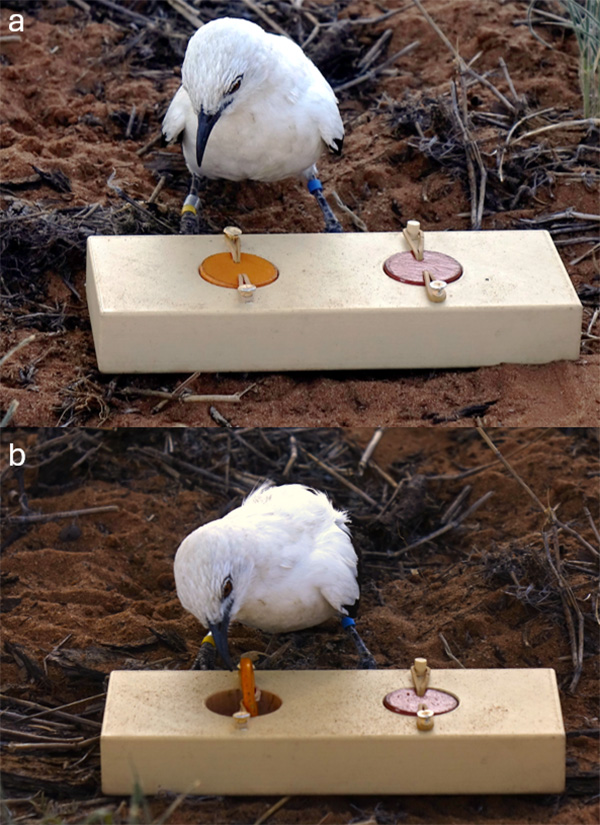 A wild pied babbler investigates a contraption that holds a tasty mealworm beneath one of two lids. The birds can learn to associate a lid of a particular color shade with the mealworm treat, but when it’s very hot, it takes the birds much longer to do so.
Credit:
Royal Society Open Science
A wild pied babbler investigates a contraption that holds a tasty mealworm beneath one of two lids. The birds can learn to associate a lid of a particular color shade with the mealworm treat, but when it’s very hot, it takes the birds much longer to do so.
Credit:
Royal Society Open Science
Another group of scientists tested zebra finches, pretty Australian songbirds, and discovered that if temperatures are high, they too have cognitive problems. When figuring out how to get a mealworm out of a see-through tube with an opening at one end, they would just keep pecking on the tube, says study coauthor Elizabeth Derryberry, an evolutionary biologist at the University of Tennessee, Knoxville. It’s the bird equivalent of “banging your head against a brick wall,” she says.
Adding to the tally, several years ago researchers showed that when the heat is on, mice have trouble finding their way around a maze and forget objects they’ve seen the day before. More recently, researchers found that male guppies, popular aquarium fish, also have trouble getting through a maze after spending several days in heat-wave-like 90° water, even if the prize for getting it right is a virgin female—which they tend to find particularly attractive.
For animals such as fish and insects that can’t control their body temperature, heat waves could be particularly detrimental. “Changes in air temperature will affect brain temperature,” says Baird. A hotter brain could hinder the functioning of nerves, and that, she says, “might affect sensing, memory, and learning.”
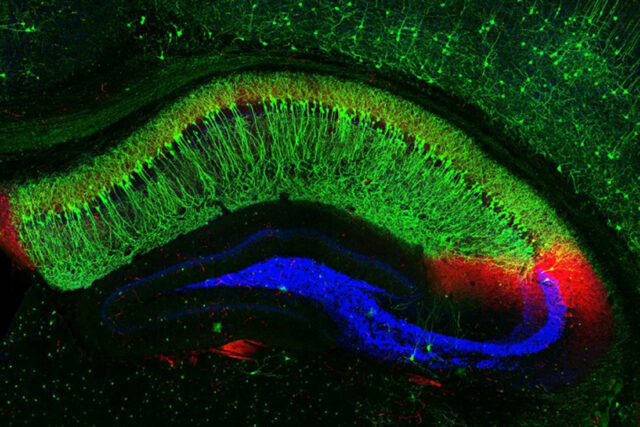 Cross section shows band of cells in the mouse hippocampus.
Credit:
RAUNAK BASU / UNIVERSITY OF UTAH, SALT LAKE CITY
Cross section shows band of cells in the mouse hippocampus.
Credit:
RAUNAK BASU / UNIVERSITY OF UTAH, SALT LAKE CITY
When Baird and colleagues tried to teach bumblebees to associate sweet sucrose with the color blue and bitter quinine with yellow, most of the bumblebees learned the trick at 77°, but fewer than half managed to do so at 90°. Such impaired cognition could spell trouble in the field: If the insects forget which flowers they should pollinate (in the case of bumblebees, these include tomatoes and blueberries) or how to get back home with nectar, not only will the pollinators suffer, but human agriculture too, Baird says.
Heat appears to dangerously diminish animal vigilance as well. In Ridley’s recent experiments, once mercury in the Kalahari Desert reached 96° F, pied babblers lost their ability to properly respond to predators. In their studies, researchers lured birds toward a mystery shape covered in a sandy-colored blanket, using worms as bait. Once a babbler approached, the scientists would reveal what was hidden underneath: either a taxidermied cat-like carnivore called a genet, or a similarly sized and colored wooden box. The birds got scared of the genet in cooler temperatures—they’d call out, scan their surroundings, or simply flee. But once it got hot, they behaved similarly whether they were facing the carnivore or the box. Ridley suggests that this could translate into higher chances of fatal predator attacks as heat rises, which could harm populations of babblers and other prey species.
These studies are not just abstractions. In the Kalahari, where southern pied babblers use their wits to search for worms, temperatures are rising twice as fast as the global average. In tropical rivers, where male guppies seek mates, heat waves are growing longer and more intense. It’s the same story across much of the planet—temperatures climb, and animal thinking becomes strained, potentially putting species at risk. The effects may be magnified in certain areas such as cities, which often exhibit even warmer temperatures than non-urban areas. If anything, Ridley says, “We are probably underestimating the impacts of increased heat on animal minds.”
This story originally appeared on Knowable Magazine.
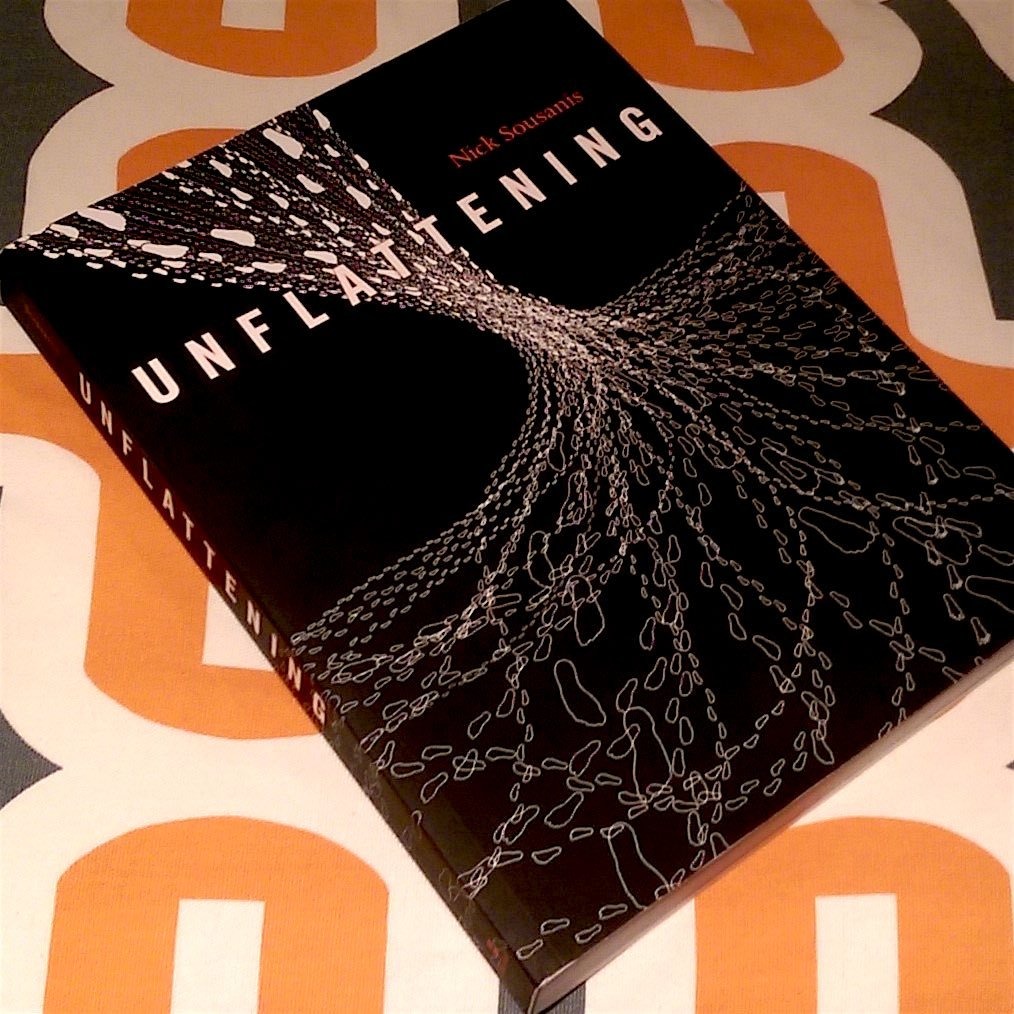
Unflattening
by Nick Sousanis
Harvard University Press
2015, 208 pages, 7.5 x 10.2 x 1 inches
It is remarkable how much we learn in our youth and how fast we learn it. It is a pace that really cannot sustain itself as we age, though we might try to continue to learn as though we were young. In my youth, the newspaper seemed a vast swarm of text and a few images that encircled a hidden prize: the funnies. Comics, in youth, are acceptable, but as we age we regard them more as juvenile diversions. Over time, the picture book gives way to the novel. The non-fiction works in the form of text books and scholarly journals are tools to educate us. Finally, should we pursue learning down the institutional path long enough, we encounter doctoral theses with their many and myriad intertextual references. It is a long-standing joke among academics that it is rare that the thesis they slave over for four or more years ever actually gets read.
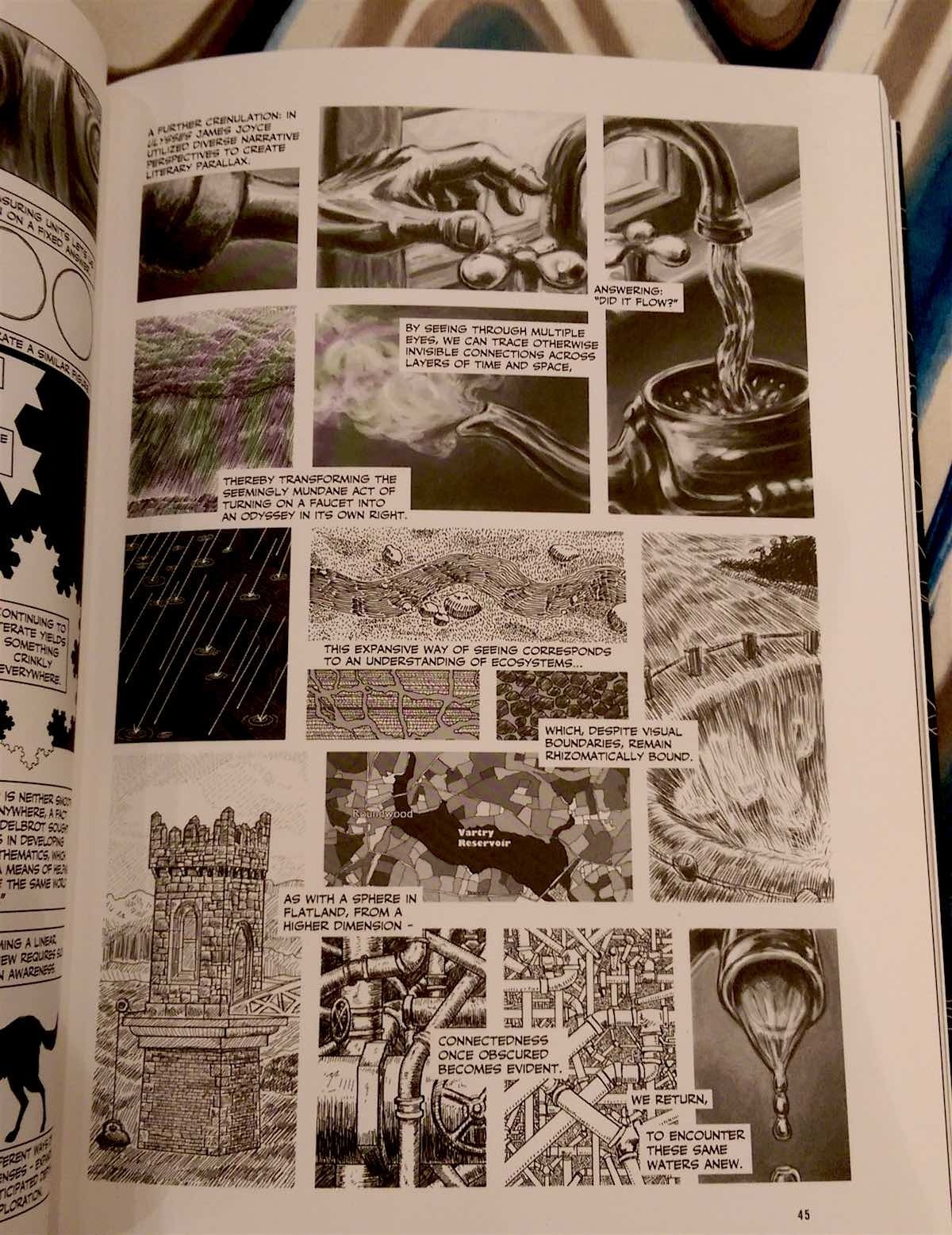
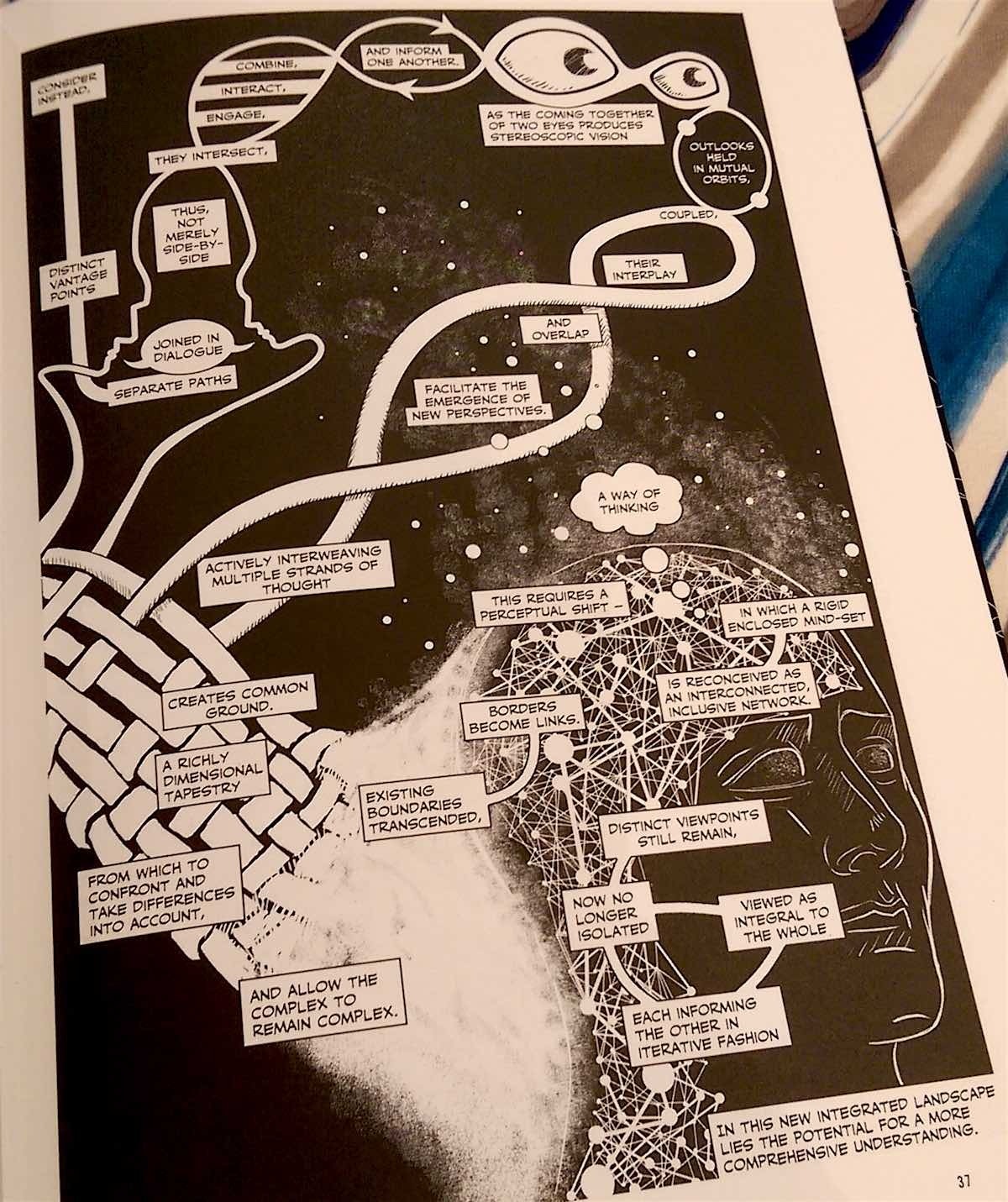
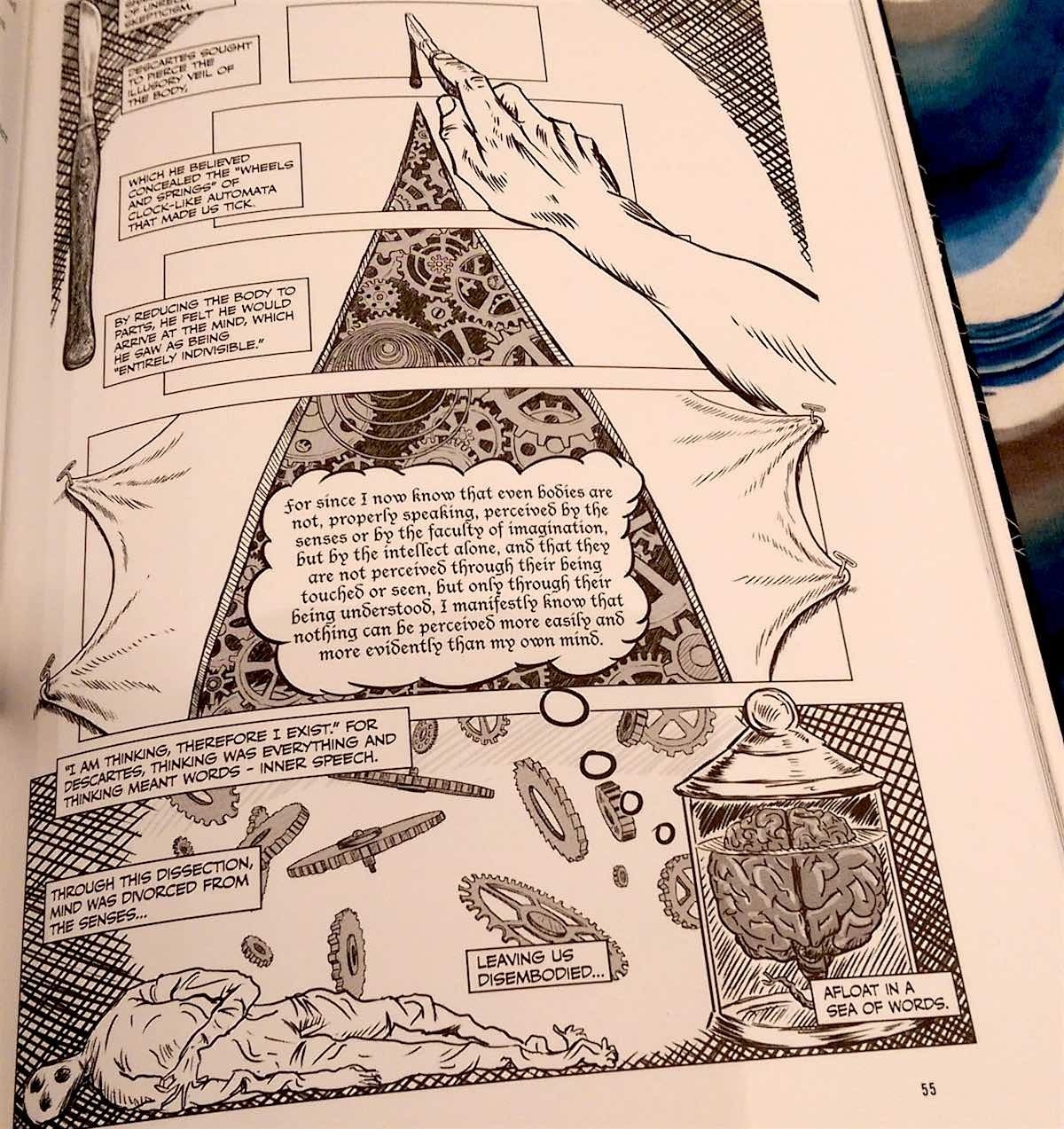
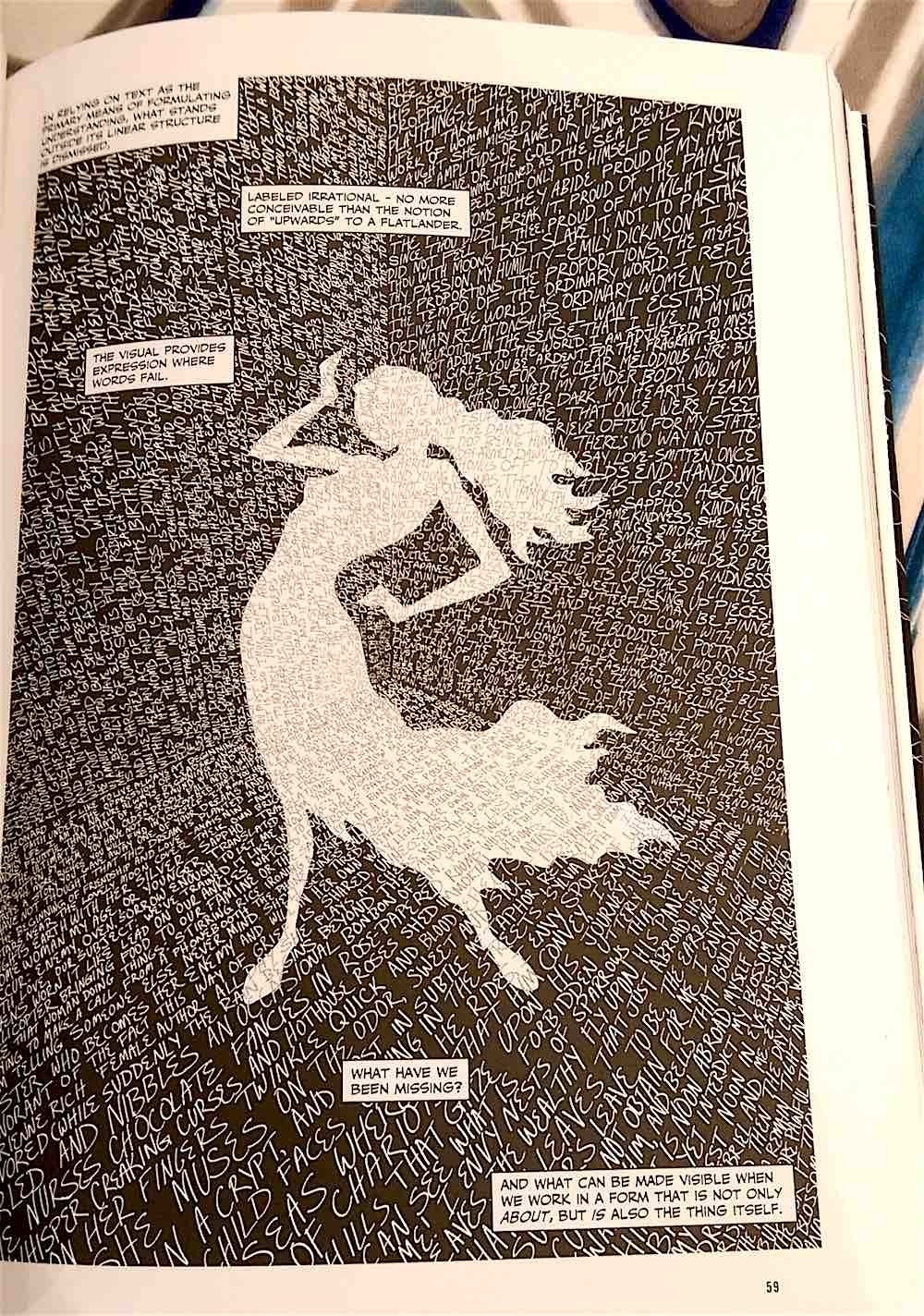
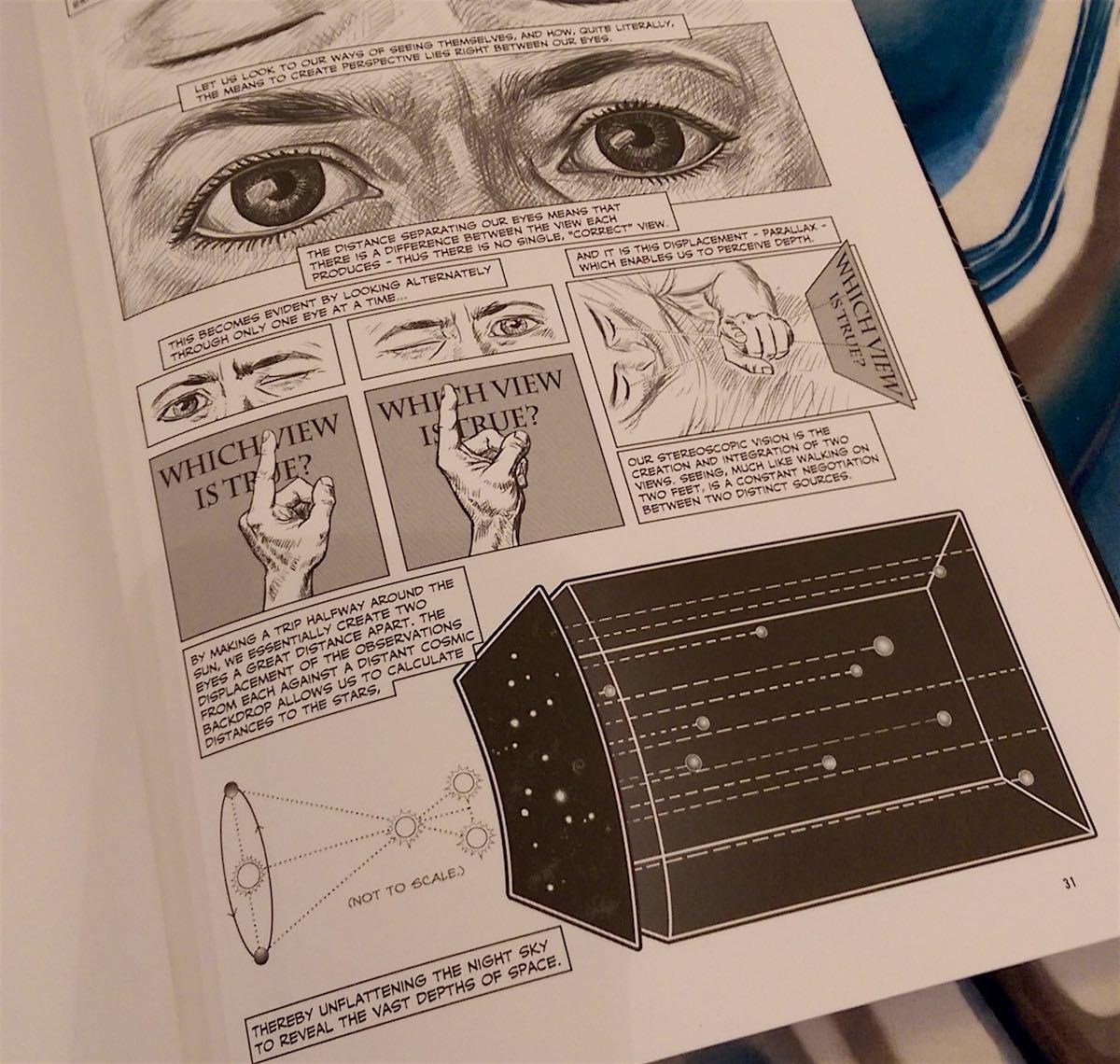
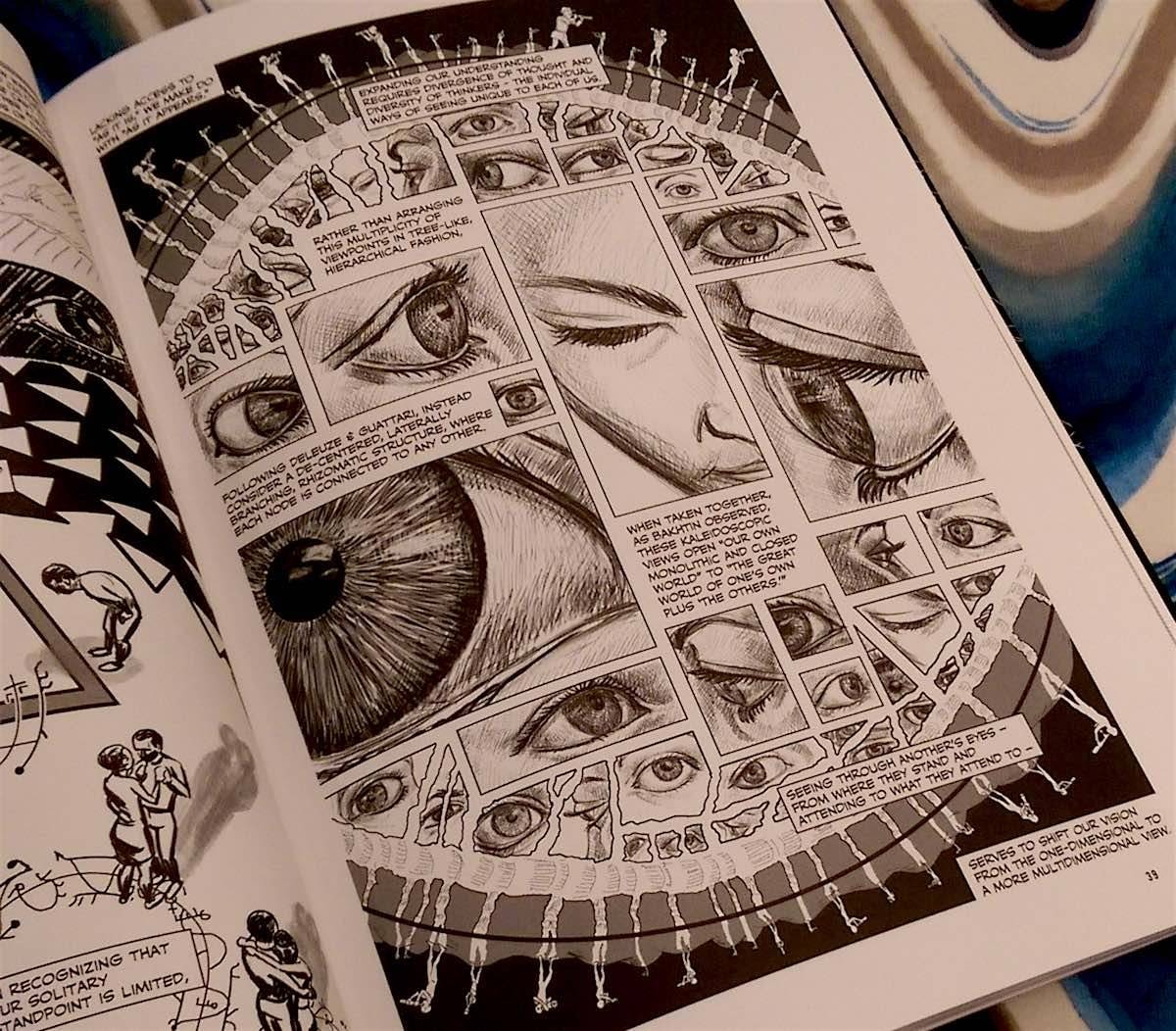
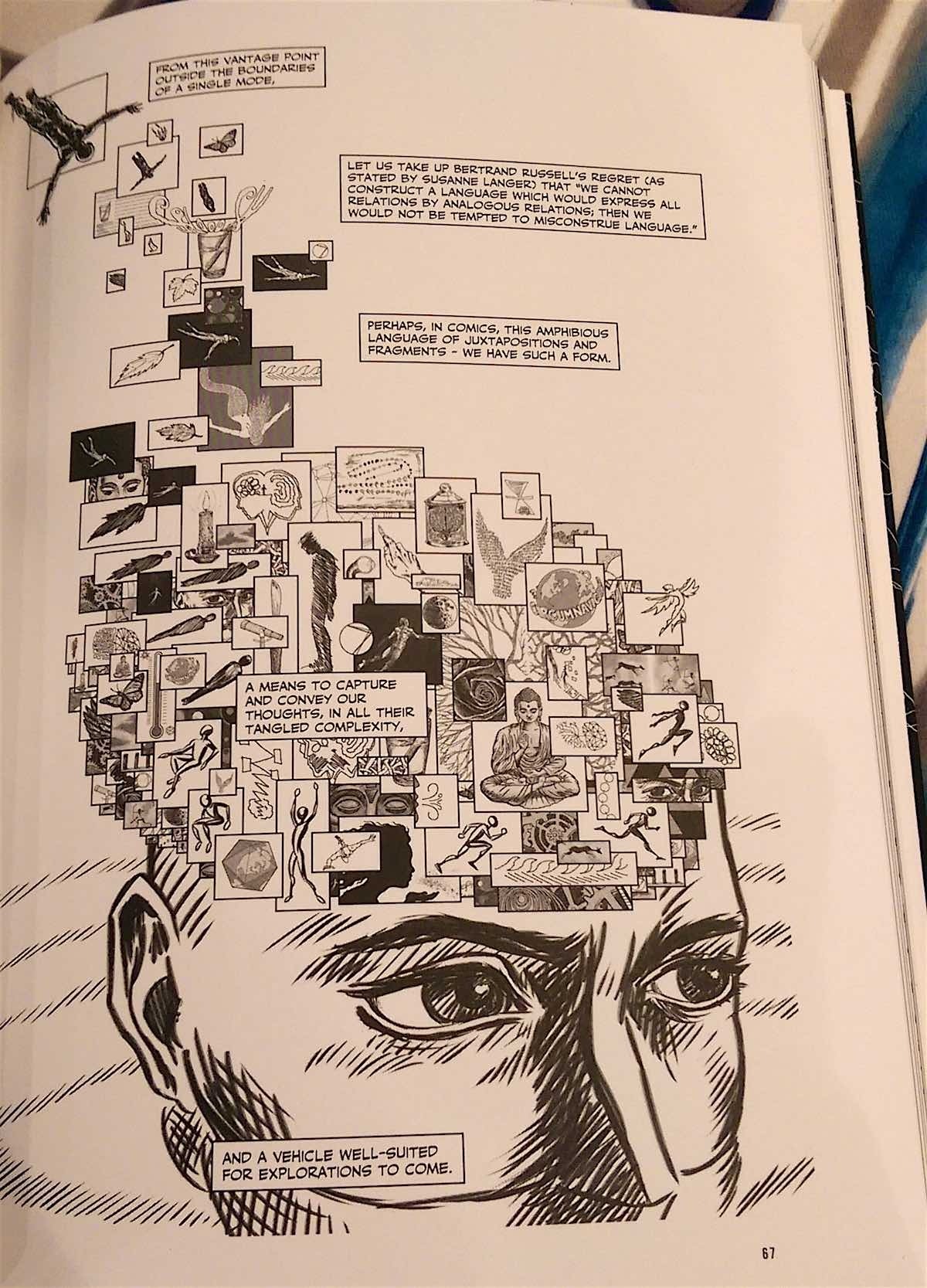
Nick Sousanis, with his doctoral thesis Unflattening, is a poignant departure from any trend of dissertations written for the sake of being written. More than that, it is meant to be more than a read work. It is an experiential work that asks the reader to not just read, but rather to participate in learning to appreciate imagery on equal terms with orderly lines of written text. This is a dissertation written in comic book format that argues for the power of that medium. One might think about the adage concerning the worth of pictures and thousands of words, and that does come up in the work itself, but this is something more than a trite saying. It is a masterful reinterpretation of how we read and learn, and how our world can be captured and conveyed to our fellows. It dismantles the rigid presumptions we have regarding the inherent value of the written word – especially scholarly writing. It champions the comic, for “while the image is, the text is always about.” Indeed, it is brilliantly argued throughout that “the visual provides expression where words fail.”
The title, Unflattening, refers to Edwin A. Abbott’s novella Flatland (1884), about a dystopian flatland of two dimensional objects, where a coin would not be seen by others for its circular shape, but rather would be seen edge-on as just a line obscuring the horizon. This is a “linelander,” and all linelanders see each other this way. A square of three dimensions frees the coin-shaped object by peeling it from the flat surface so that it might see its brethren and world from above – from the third dimension, just as we would look down upon a page in a geometry textbook
Sousanis, similarly, wishes to peel us away from the linear predominance of the textual world where word follows word follows word. He comes from a background in comics, graphic novels, or whatever phrase you would use to describe his art. Just as his square peels away the coin from lineland to reveal it to be flatland, so too Sousanis convinces us, by both text and deed, of the power of comics. His text is often sparse and pared down to its most necessary elements, but the accompanying visuals draw the eye along and serve as an obvious example that reinforces the sometimes vague text. The deed is the image, for it is the more obvious representation of our lived world, while the text can only describe it. This may all seem obvious, but Sousanis brings to bear so many examples and graphical displays to reinforce his line of argument, that the journey through this work is quite remarkable. Moreover, his endnotes at the back serve not only to acknowledge his textual sources, but also to draw attention to and explain his visual inspirations. Those images that so often sit confined within frames within museum galleries or as a ghettoized section of glossy pages in the middle of an art book, they are given life and agency by Sousanis’ deploying of them as allies to his words.
Certainly, it is almost with chagrin that one must only write about such a work when it argues so convincingly that mere text is limited in its conveying of full meaning. It is some solace that the accompanying images from Sousanis’ work will allow readers of this review to gain greater insight in the majesty of his pairing of imagery and text. This is a thinking person’s book and it is most definitely academic, but it is also surprisingly accessible. It draws upon – and draws – so many disciplines and so many real-world instances, that anyone and everyone will find it illuminating. So profound are many of these moments of illumination that they go a long way to rejuvenating our desire to see the world anew, from a child’s eyes once more. – Stephen Webb.
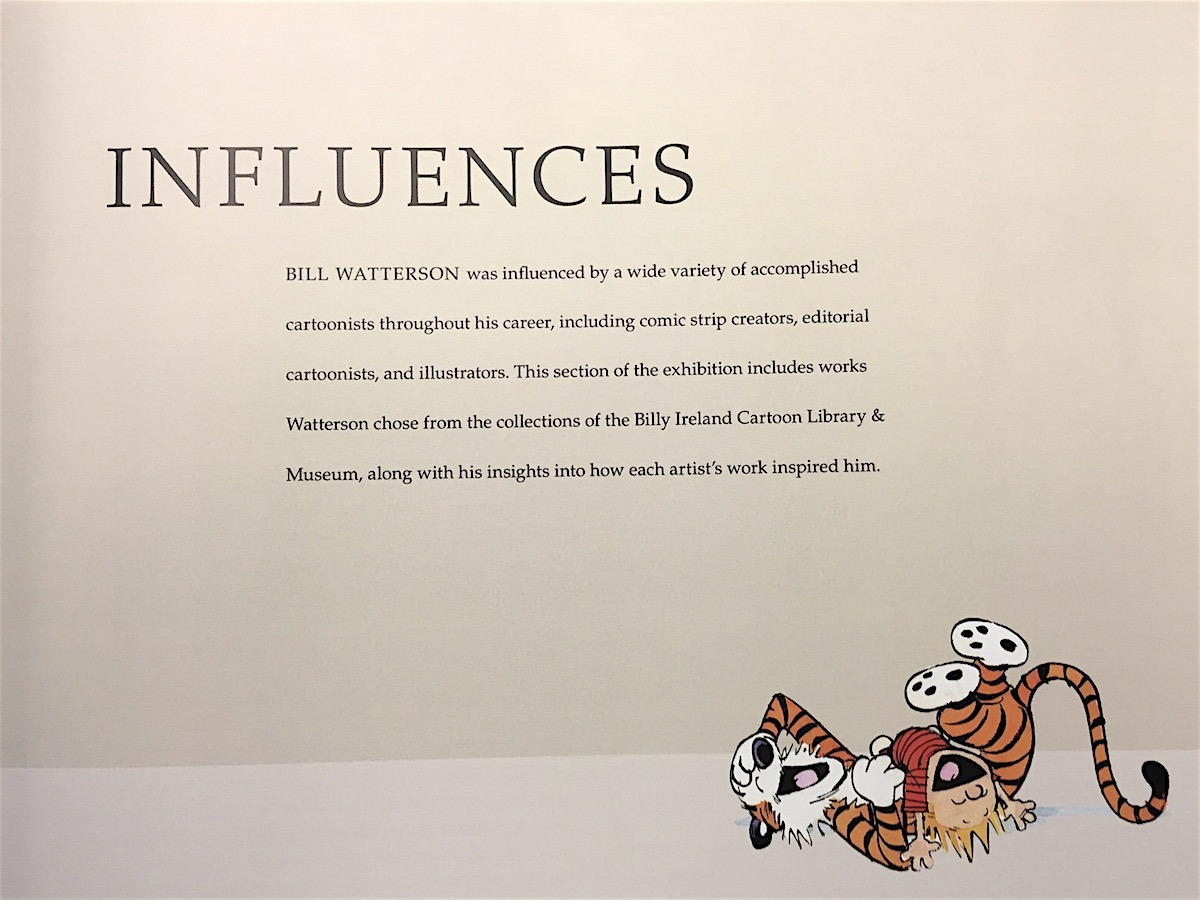
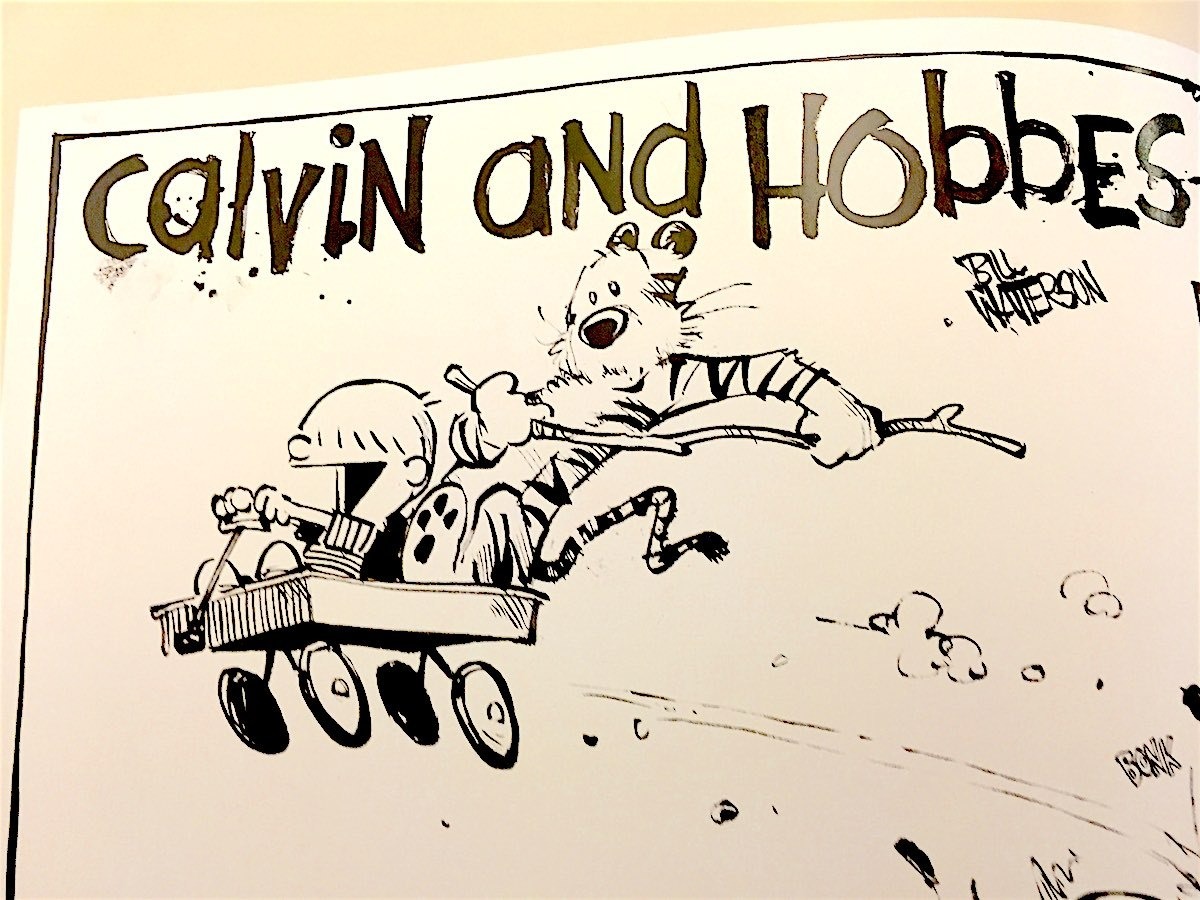

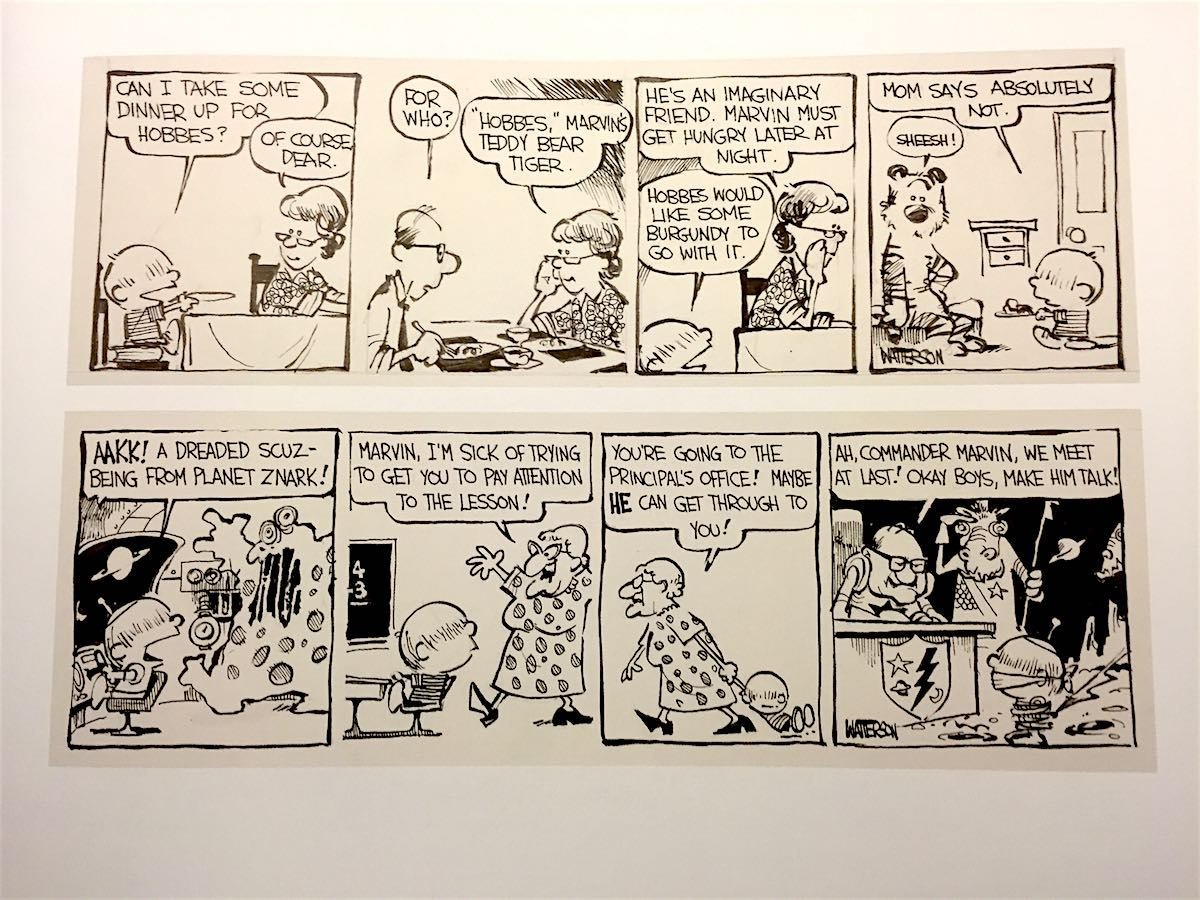
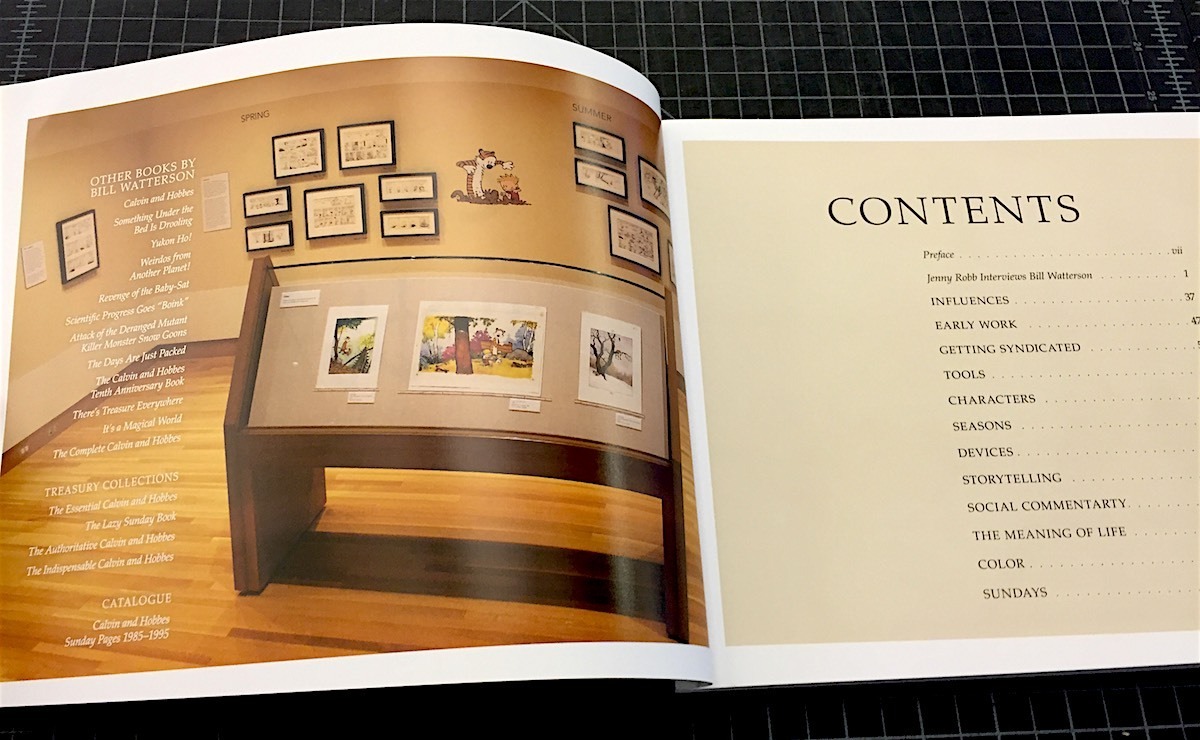
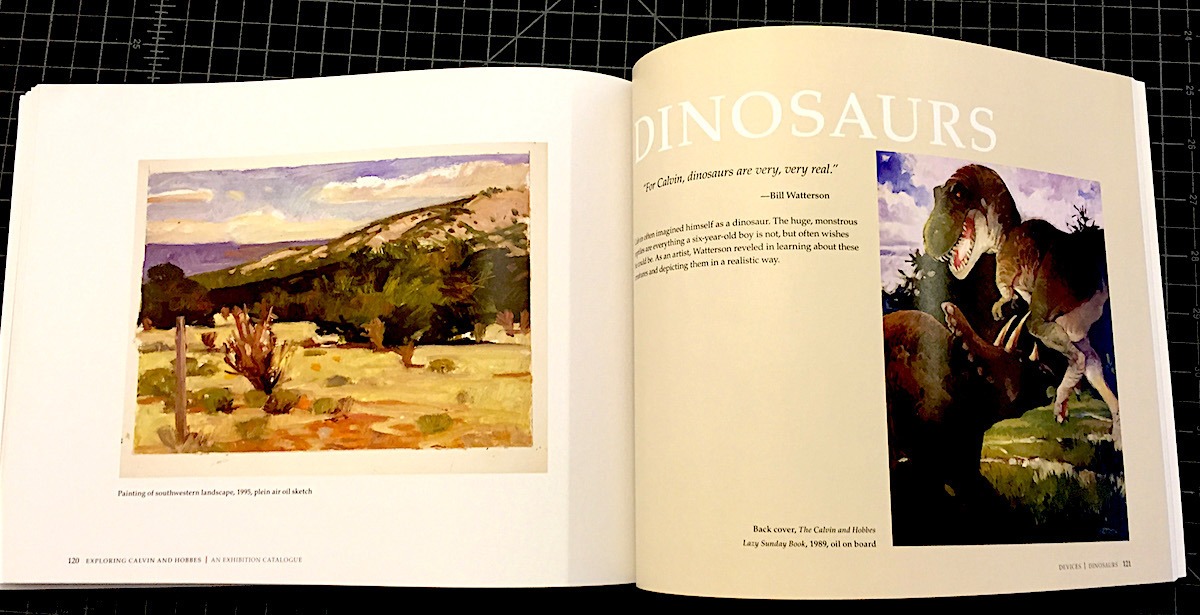
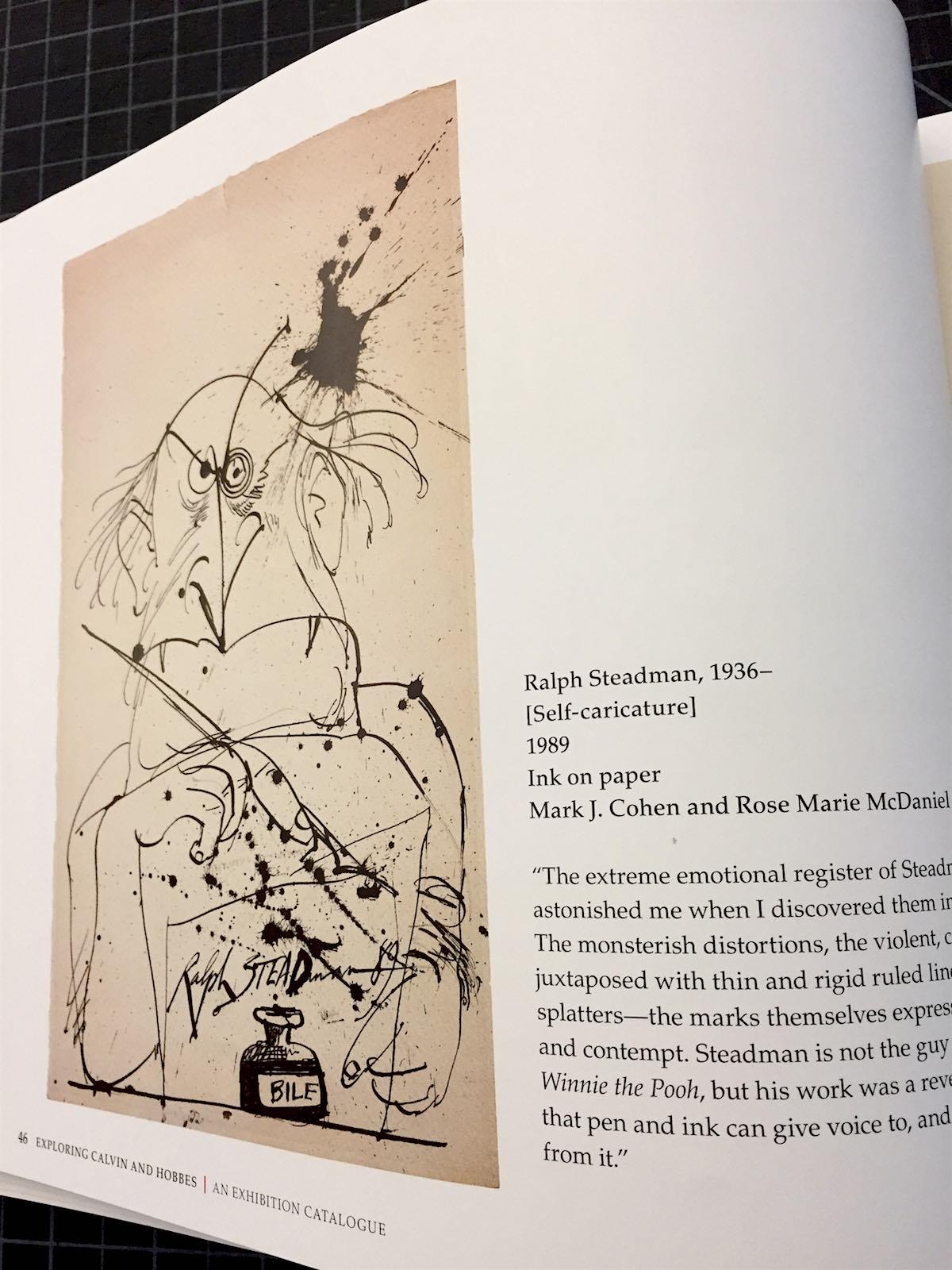
Exploring Calvin and Hobbes: An Exhibition Catalogue
by Bill Watterson and Robb Jenny
Andrews McMeel Publishing
2016, 160 pages, 8.5 x 11 x 0.6 inches
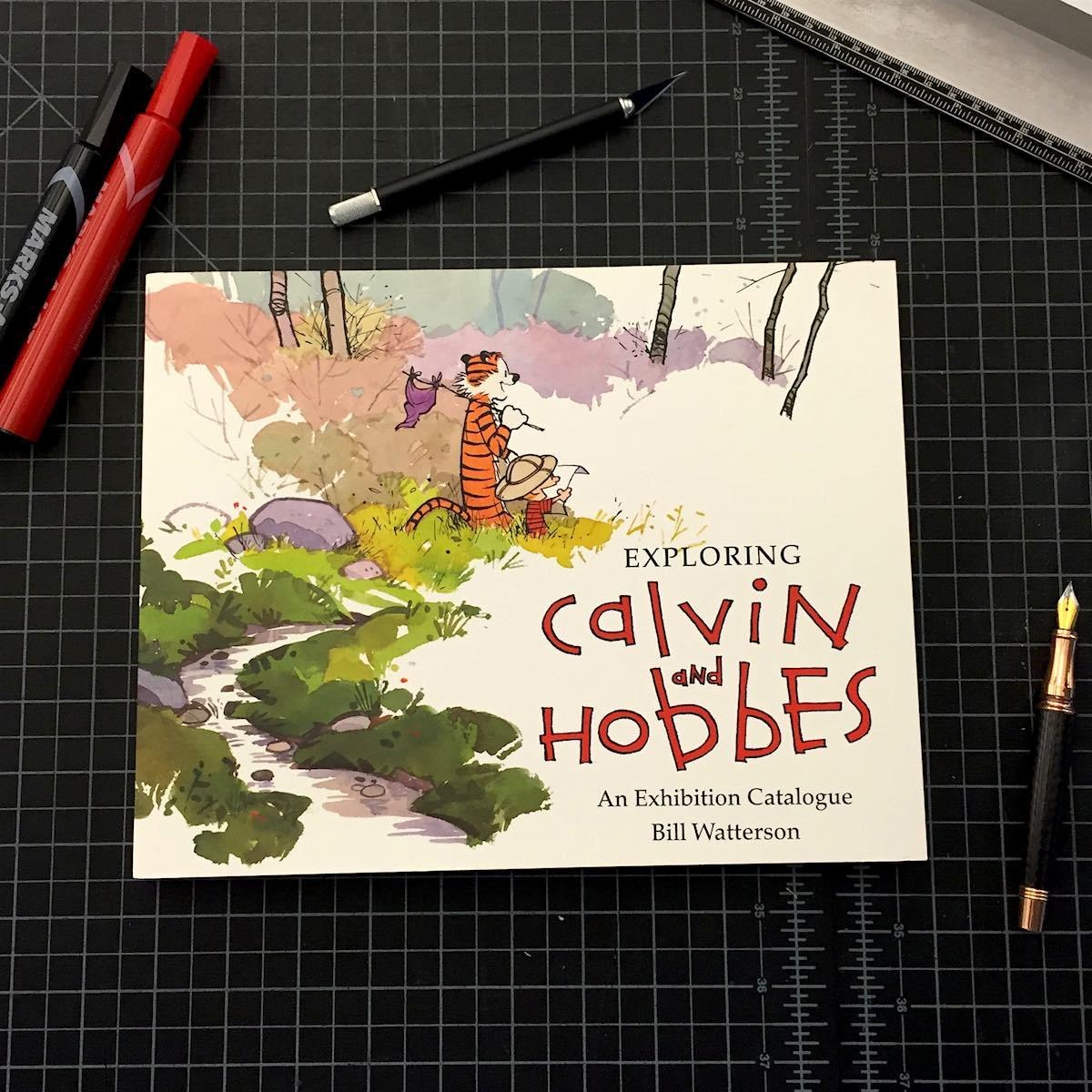
I like many grew up on Calvin and Hobbes. I don’t know if there’s a comic, book, film, or any other piece of art that better captures a childhood. I read every Sunday strip, most of the dailies, and the ones that I missed I would read in dog-eared collection books checked out from the library. As I got older, I wanted to know more about the strip’s creation. When I picked up the Complete Calvin and Hobbes, a 14-pound tomb, I was a little disappointed. Other than an introduction, there was very little information about the mysterious creator Bill Watterson. Thankfully, Exploring Calvin and Hobbes: An Exhibition Catalogue makes up for that.
This is the Blu-Ray extras that Calvin & Hobbes fans have been waiting for. It’s not for those casually interested in reading the strip. There are plenty of other books for that. But if you’re interested in process, history, and the inspiration behind a boy and his tiger, you’re going to love this book.
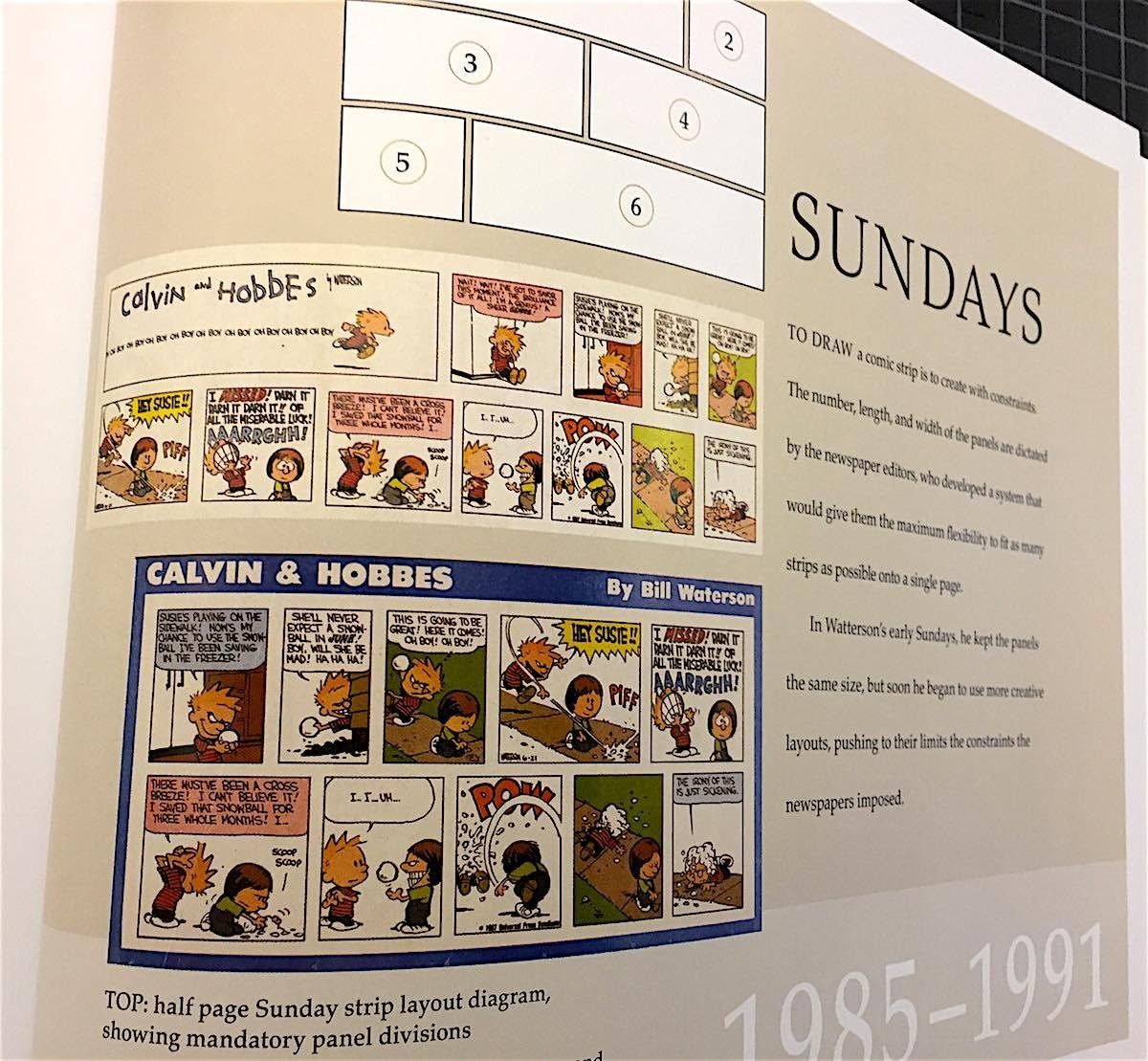
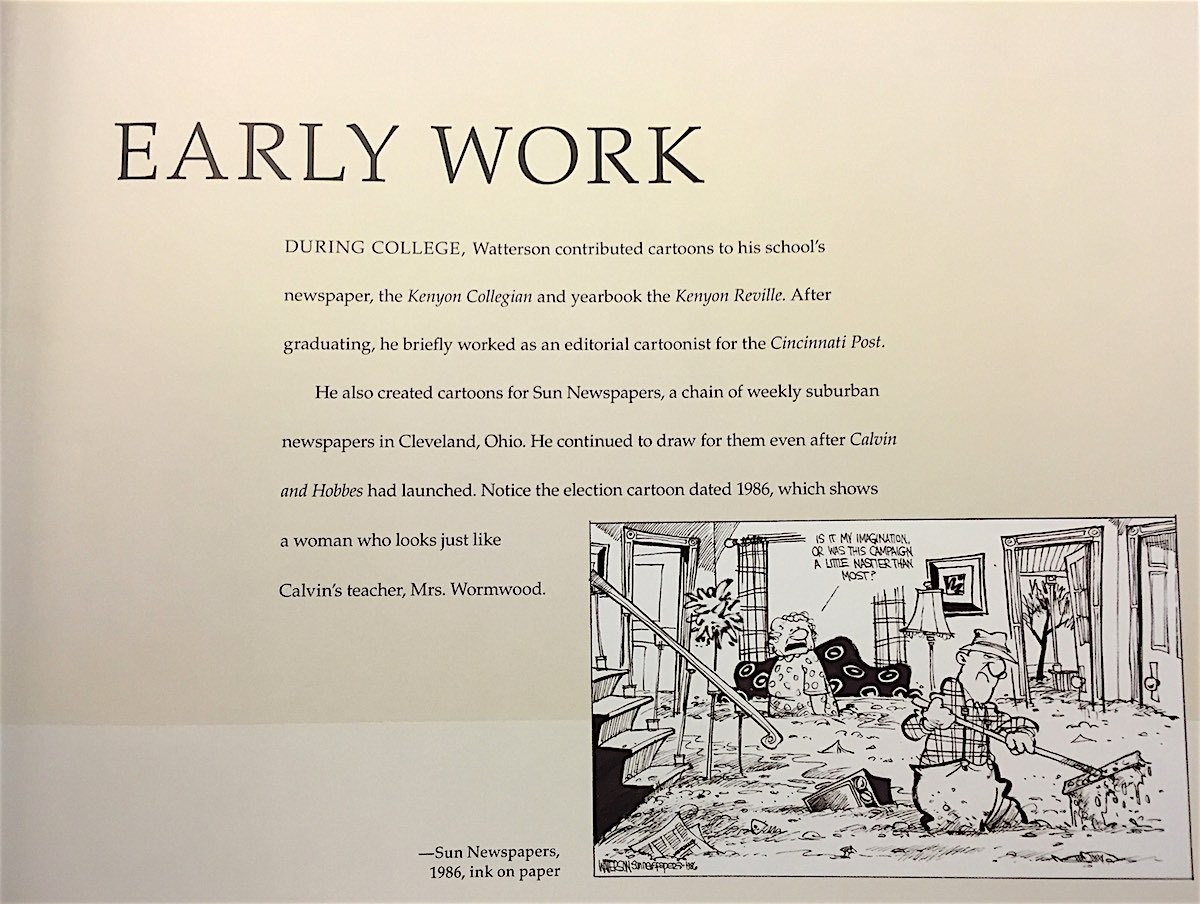
The book explores an exhibit of Watterson’s work at the Billy Ireland Cartoon Museum. It also includes one of the most in-depth interviews he’s ever given. In it you get a rare look at his early work, the tools Watterson used, the struggles he went through, and the wonderful comic that he created. You get a real sense of the artistry that Watterson put into the strip, and how it evolved over the years. It’s great to relive and learn about something that had such an influence on me. This book is definitely a must-have for Calvin and Hobbes fans. – JP LeRoux
Books That Belong On Paper first appeared on the web as Wink Books and was edited by Carla Sinclair. Sign up here to get the issues a week early in your inbox.
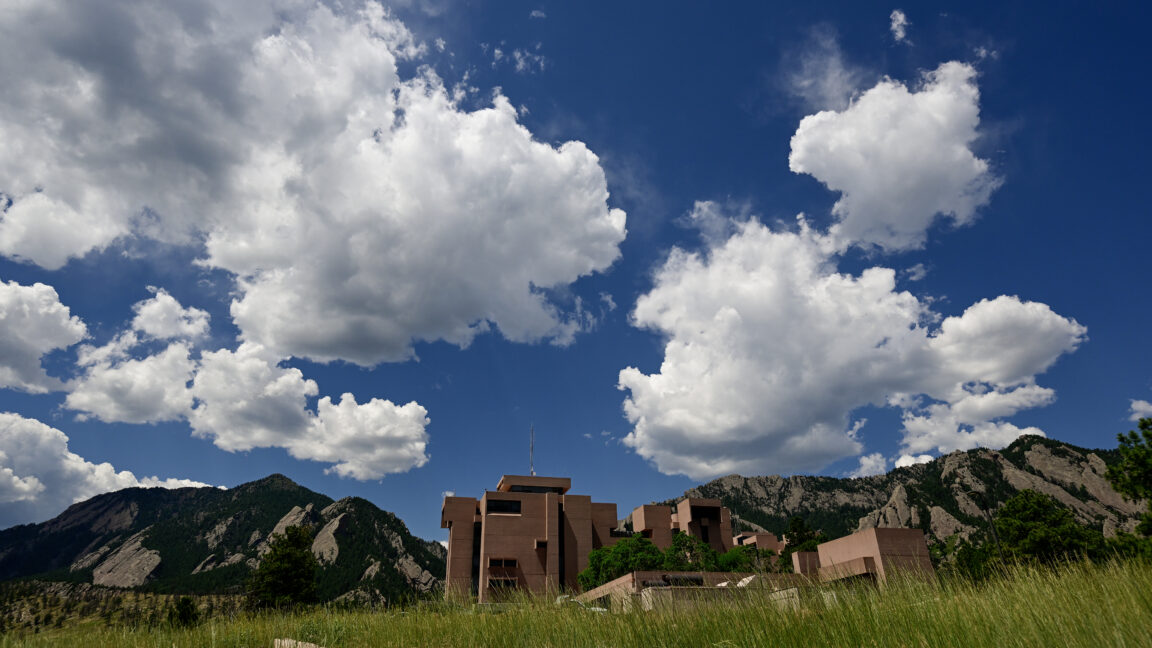
In December, the Trump administration abruptly announced it would shut down the National Center for Atmospheric Research (NCAR), a Boulder, Colorado-based facility that helps researchers perform studies of weather, climate, atmospheric chemistry, and more. The news came as a shock, given that the government had never identified serious deficiencies in the management of NCAR and its associated supercomputing center in Wyoming.
Nevertheless, the government ordered the University Consortium for Atmospheric Research (UCAR), which manages NCAR on behalf of the National Science Foundation, to help it prepare to transfer the Wyoming to a different operator. UCAR sued the government and, on Monday, won a preliminary injunction that places the transfer of the facility on hold.
NCAR is what is termed a "Federally-Funded Research and Development Center" meant to support researchers in the academic community. Rather than having its own research agenda, it provides facilities, equipment, and expertise to support projects that are too large or complex for researchers to pursue on their own. NCAR has been around since the early 1960s and has become a critical resource for the global atmospheric science community.
So, it was a shock for many that the government would attempt to shut it down and distribute the resources it maintains, such as research aircraft and the supercomputing center. The government solicited public feedback on that decision, but UCAR took no chances and sued. As part of that suit, UCAR sought a preliminary injunction that would put the transfer of its supercomputing center on hold.
To get that injunction, UCAR would have to show that it was likely to prevail and that it would experience irreparable harm if the court didn't intervene.
The judge in this case, Brooke Jackson, ruled that the issue was one his court could address based on the Administrative Procedures Act. The government had argued that no decision had been made, and therefore that there were no grounds for the suit. But Jackson noted that as early as February—before the public comment period on the decision had even closed—government officials were telling UCAR that "[the National Science Foundation] has decided to transfer stewardship" of the supercomputing center.
By early March, a government program director was telling UCAR that he needed to "get this done quickly" and that documentation of the supercomputing center needed to be handed over "yesterday." Even now, months after the deadline for public feedback on the decision, the government admits it hasn't fully evaluated the comments it received. "The sequence of events strongly suggests that the outcome was predetermined," the decision notes.
For all of those reasons, he concluded that the NSF had already reached a final decision on the transfer of the supercomputing center, and that decision was subject to review under the Administrative Procedures Act, which is what the rest of the case hinged on.
As in so many other cases that have made their way into the courts, the government does not seem to have been prepared to offer much of a defense of its actions. The Administrative Procedures Act prohibits actions that are "arbitrary and capricious," and Jackson found that there was a "failure to articulate any rationale" for the decision to relieve UCAR of its management role.
He noted that some internal documents introduced as evidence indicated that there was dissatisfaction with NCAR's pursuit of climate research and hosting of scientific programs intended to improve minority participation. But the government chose not to use those as arguments, so the court didn't need to evaluate them. UCAR, in contrast, introduced significant evidence that the decision to harm NCAR was part of a range of measures meant to pressure Colorado's Democratic governor about an unrelated matter.
Given that, the court concluded that forcing UCAR to give up its supercomputing center was arbitrary and capricious, and thus violated the Administrative Procedures Act.
UCAR was also able to demonstrate that it was suffering irreparable harm due to the uncertainty about its future. It has experienced unusually high levels of attrition among its staff, who have a rare set of technical skills and require additional training after hiring. And it expects it will be difficult to find replacements for them.
Given those circumstances, Jackson has issued an injunction blocking the government from forcing NCAR or UCAR to give up any resources related to the supercomputing center.
There are still additional threats to NCAR, including breaking it up, transferring other resources, and even selling its Boulder headquarters. So, this victory is far from the end of the threats. But the legal issues that decided the case are likely to apply to the additional threats, unless the government has a defense that it simply chose not to present here.